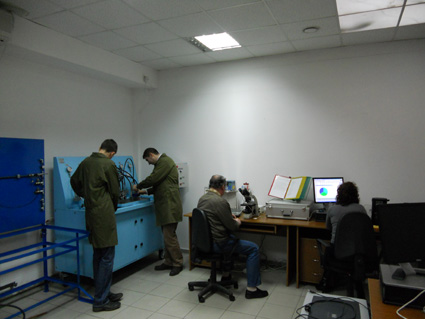
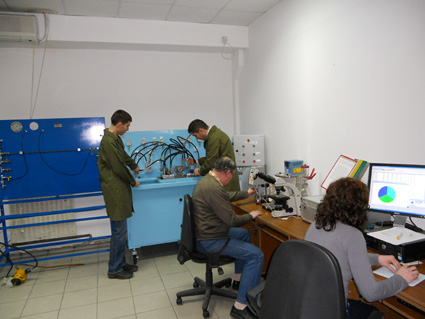
LABORATORY of Fluid Mechanics
Key words: Hydraulic equipment, research, fluid contamination testing, hydraulic fluid characteristics, industrial installations, mobile equipment. Testing, laboratory training, hydraulic drive schematic diagrams
Key areas of expertise, capabilities, competencies - laboratory description:
The laboratory conducts research in the field of hydraulic drive fluids, their quality and the influence of the degree of contamination on operation.
Type of services:
Experimental research on the quality of the working fluid. Functional validation of hydraulic equipment after repairs. Experimental research for the functional optimization of equipment by analyzing the quality of working fluids.
-
Specialized consulting to reduce maintenance costs.
Description of the services provided by the laboratory:
The laboratory conducts research and verifications on the influence of the types and quality of the hydraulic working fluid on the performance and lifespan of hydraulic equipment. The compatibility of the working fluid with hydraulic equipment is studied, as well as the influence of different hydraulic fluids on the environment. The laboratory provides research and training services in the development and optimization of drive schematic diagrams.
Certifications/Authorizations/Accreditations held by the laboratory: FM 14404 Quality Management System Fluid contamination certificate
Contact data: Phone: 021 336 3991, Fax: 021 337 3040; e-mail: sefu.ihp@fluidas.ro; EERTIS Platform |
The laboratory is intended for research on:
1. Measuring contamination of working fluids used in industrial fluid power applications;
2. Measuring characteristics of working fluids used in industrial fluid power applications (viscosity, temperature);
3. Measuring flow in circular pipes under pressure with different types of devices (flow sensors, flow transducers, diaphragms, etc.);
4. Checking equipment for measuring pressure in fluid power systems;
5. Measuring the speed of drainage in pipes of circular section;
6. Measuring switching forces in some distribution equipment;
7. Determining the average rate of leakage in pipes of circular section.
|